


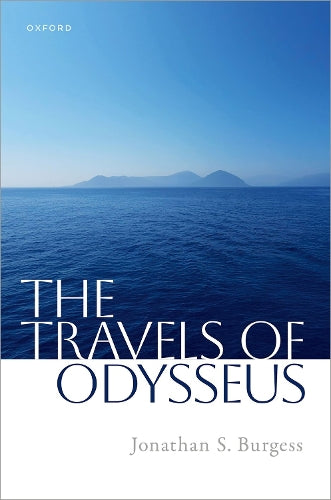
The Travels of Odysseus by Jonathan S Burgess
The Travels of Odysseus employs the theme of travel to explore the Odyssey and its contexts. After an introductory chapter, Chapter 2 provides analysis of the “wanderings” or Apologos of Odysseus, Chapter 3 explores the “lying tales” told by Odysseus in disguise upon his return to Ithaca, and Chapter 44 discusses a variety of stories about Odysseus leaving Ithaca again (including Teiresias' prediction of an “inland journey” and the Telegony of the Epic Cycle). The introductory chapter explores various contexts of Odysseus' travels: the Epic Cycle (notably the Nostoi (“Returns”) and the Telegony), comparable travelers of myth (Gilgamesh, Heracles, Perseus), the genre of travel writing, ancient and modern, and the characterization of Odysseus within Homer and outside of Homer. Chapter 2 explores the hero's account of his wanderings to the Phaeacians in Books 9-12 by exploring the poem's explanation of the hero's nostos (“return”) in the proem, the spatial and temporal aspects of the wanderings, the Phaeacian context of the Odysseus' stories, the implications of the ancient term apologos for Odysseus' “wanderings,” the patterns, causality, and plot of the Apologos, and the socio-economic aspects of the “wanderings.” Chapter 3 explores the actions of Odysseus upon his return to Ithaca. Topics include the Homeric and non-Homeric aspects of Ithaca, the motif of “lying travelers at Ithaca,” the themes of the false travel tales that Odysseus tells while in disguise, the function of these “lying tales” to “test” suitors, slaves, and family, and an extensive comparison of the “lying tales” to the “wanderings.” Chapter 4 first discusses issues arising at the end of the Odyssey, which are described as indicative of existing or potential further adventures of Odysseus. These post-nostos travels include Teiresias' prediction of the need to take an “inland journey,” Odysseus' travel to Thesprotia in the Telegony, and other lost tales about Odysseus traveling to northwest Greece or the Italian world. Many tales involve locations linking themselves to the hero through genealogy or burial place.
Jonathan S. Burgess is Professor of Classics at the University of Toronto. His previous publications include The Tradition of the Trojan War in Homer and the Epic Cycle (Johns Hopkins University Press, 2001), The Death and Afterlife of Achilles (Johns Hopkins University Press, 2009), and Homer (I. B. Tauris Press, 2015).
| SKU | Unavailable |
| ISBN 13 | 9780198891499 |
| ISBN 10 | 0198891490 |
| Title | The Travels of Odysseus |
| Author | Jonathan S Burgess |
| Condition | Unavailable |
| Binding Type | Hardback |
| Publisher | Oxford University Press |
| Year published | 2025-06-26 |
| Number of pages | 256 |
| Cover note | Book picture is for illustrative purposes only, actual binding, cover or edition may vary. |
| Note | Unavailable |