


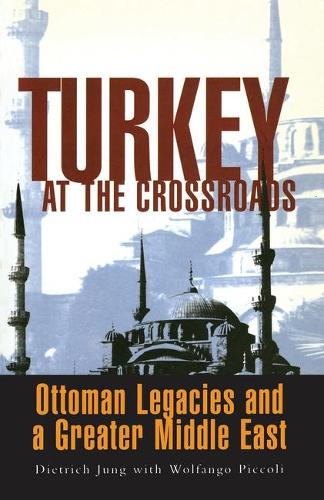
Turkey at the Crossroads by Dietrich Jung
Turkey's future will be shaped fundamentally by the fate of its Kemalist legacy. A range of ideological currents today - Kurdish nationalists, Islamists, and so-called neo-Ottomanists - are all challenging the received, and still dominant, Kemalist version of the country's history. This book argues that Turkey cannot meet adequately the challenges and opportunities which its Middle East location offers (both its near neighbours and its more distant Turkic cousins in the newly independent states of Central Asia) so long as its ruling elite and its politically influential military continue to deny the significant continuities between the country's imperial Ottoman past and the Kemalist project of the 20th century. The authors examine Turkey's attempts at modernization, starting with the Ottomans' own reform attempts and accelerating with the Kemalist Republic and the country's growing orientation towards the West since 1945. They look at the challenge to Kemalism that Islamism and Kurdish nationalism have posed more recently. And they explore the difficulties and possibilities that Turkey faces in its hinterland - its Arab and Persian neighbours, Central Asia, and Israel. How it plays out its role as a regional actor will, they argue, be decided by the outcome of the profound ideological and political conflicts within the country. More particularly, Turkey cannot take modernization and democratization further until it faces up to the authoritarian legacy that Ottoman political culture passed on to the Turkish Republic.
'In the light of Turkey's EU accession process, this book provides a comprehensive and lucidly argued analysis of the political challenges that this country lying between Europe and the Middle East has to faceIn focusing on still visible Ottoman-Turkish continuities, the authors touch on the sore point of Kemalism and present a refreshing interpretation of modern Turkish history.' Udo Steinbach, German Institute for Middle East Studies, Hamburg 'By emphasizing the relevance of Ottoman-Turkish continuities for the current problems of Turkey, and also bridging the gap between international relations and domestic politics, the authors offer an excellent corrective to the conventional analyses of this country. Their rich synthesis and weaving together of historical and social perspectives enable them to address the fundamental questions of Turkish democracy.' Umit Cizre, Bilkent University
Dietrich Jung is a political scientist who specialises in the Islamic world. Currently a research fellow at the Copenhagen Peace Research Institute (COPRI), he has taught at the University of Hamburg and in 1997-98 was a visiting assistant professor at Bilkent University in Ankara. His co-author, Wolfango Piccoli, is an Italian political scientist resident in Turkey.
| SKU | Unavailable |
| ISBN 13 | 9781856498678 |
| ISBN 10 | 1856498670 |
| Title | Turkey at the Crossroads |
| Author | Dietrich Jung |
| Condition | Unavailable |
| Binding Type | Paperback |
| Publisher | Bloomsbury Publishing PLC |
| Year published | 2001-10-01 |
| Number of pages | 240 |
| Cover note | Book picture is for illustrative purposes only, actual binding, cover or edition may vary. |
| Note | Unavailable |