


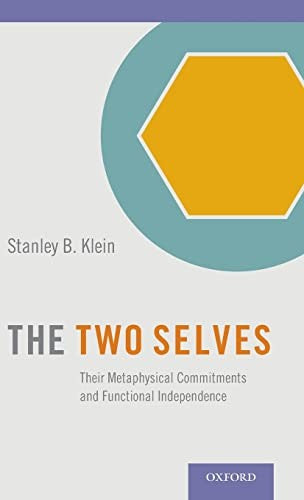
The Two Selves by Stanley B Klein
Our experience of a unified sense of the self is underwritten by a multiplicity of self-aspects having very different metaphysical commitments. Our experience of unity is provided by a process-which, under certain clinical conditions, is rendered inoperative-that enables a person to experience mental states as personally owned.
Klein's argument is convincing, and any disagreement with the details of his view should be dwarfed by the admiration for the originality of his approachWhile Klein's home discipline is psychology, this is as much a book of philosophy as it is of psychology. Such truly interdisciplinary work is, unfortunately, extremely rare. * Kourken Michaelian, Minds & Machines *
Klein not only succeeds in producing a cogent argument for distinguishing between these two senses of "self," he produces a clear characterization of them. These successes alone would have made this book well worth reading, but Klein does more. He shows that one fruitful avenue for enhancing our understanding of self is to attend to abnormalities of belonging, those instances wherein the relationship between self and its experiences is disrupted. I believe the search for a "mental glue" that binds the self to its experiences will help to focus, invigorate, and integrate research spanning multiple fields, as well as lead to a comprehensive framework for understanding self, that elusive datum about which all else revolves. * Timothy Lane, Taipei Medical University *
This is a wholly original book that derives from the distinctive, creative and (in my view) downright brilliant insights of the author. The book powerfully points out that the epistemological self is, if anything, over-studied, while the ontological self (of experience) is sadly neglected empirically and conceptually. The scholarship is impressively wide and deep, demonstrating a thorough and sophisticated knowledge of contemporary research on the self and social cognition as well as current philosophy of mind and of science-two knowledge stores that are rarely to be found within the same brain, let alone the same book. * David Funder, Professor of Psychology, University of California *
Klein is a profound thinker and a well-known leading force in a multidisciplinary field that deals with the ever-mysterious and fascinating issues of the human mind. One of the most prominent of these is the concept of 'self.' Klein has been at the forefront of the field of study of 'self' from the beginning. His new book takes a quantum leap forward in the field. The thesis of the book is that much of the extant uncertainty and confusion about 'self' could be cleared up by the postulation of two independent but closely interacting forms of self, which he calls epistemological and ontological. This is a fascinating idea. It is easy to imagine that it will become the focus of a great deal of philosophical and cognitive-science work on 'self' in the future. * Endel Tulving, University Professor Emeritus, University of Toronto *
My first impression when I started The Two Selves was that S.B. Klein had asked the right question. My conviction when I finished the book was that Klein had indeed come to grips with the central problem of the self. His work is a welcome effort to distinguish between the threads, with which is woven the seamless tapestry we call self. Klein has shown, not for the first time, that he is at the centre of the meaningful and intriguing project of psychologists and philosophers working together to try and understand the self. Klein's book is an essential reading for any person interested in the self and more generally, in the human mind. * L. Manning. Professor at the University of Strasbourg *
Klein not only succeeds in producing a cogent argument for distinguishing between these two senses of "self," he produces a clear characterization of them. These successes alone would have made this book well worth reading, but Klein does more. He shows that one fruitful avenue for enhancing our understanding of self is to attend to abnormalities of belonging, those instances wherein the relationship between self and its experiences is disrupted. I believe the search for a "mental glue" that binds the self to its experiences will help to focus, invigorate, and integrate research spanning multiple fields, as well as lead to a comprehensive framework for understanding self, that elusive datum about which all else revolves. * Timothy Lane, Taipei Medical University *
This is a wholly original book that derives from the distinctive, creative and (in my view) downright brilliant insights of the author. The book powerfully points out that the epistemological self is, if anything, over-studied, while the ontological self (of experience) is sadly neglected empirically and conceptually. The scholarship is impressively wide and deep, demonstrating a thorough and sophisticated knowledge of contemporary research on the self and social cognition as well as current philosophy of mind and of science-two knowledge stores that are rarely to be found within the same brain, let alone the same book. * David Funder, Professor of Psychology, University of California *
Klein is a profound thinker and a well-known leading force in a multidisciplinary field that deals with the ever-mysterious and fascinating issues of the human mind. One of the most prominent of these is the concept of 'self.' Klein has been at the forefront of the field of study of 'self' from the beginning. His new book takes a quantum leap forward in the field. The thesis of the book is that much of the extant uncertainty and confusion about 'self' could be cleared up by the postulation of two independent but closely interacting forms of self, which he calls epistemological and ontological. This is a fascinating idea. It is easy to imagine that it will become the focus of a great deal of philosophical and cognitive-science work on 'self' in the future. * Endel Tulving, University Professor Emeritus, University of Toronto *
My first impression when I started The Two Selves was that S.B. Klein had asked the right question. My conviction when I finished the book was that Klein had indeed come to grips with the central problem of the self. His work is a welcome effort to distinguish between the threads, with which is woven the seamless tapestry we call self. Klein has shown, not for the first time, that he is at the centre of the meaningful and intriguing project of psychologists and philosophers working together to try and understand the self. Klein's book is an essential reading for any person interested in the self and more generally, in the human mind. * L. Manning. Professor at the University of Strasbourg *
Stanley B. Klein, PhD, was born in New York City and grew up in Connecticut. A BA graduate of Stanford University with a doctorate from Harvard University, he has taught at University of Illinois, Champaign-Urbana; Trinity University, San Antonio; and University of California Santa Barbara, where he is currently in the Psychology Department. Klein has been a member of the APA, Psychonomic Society, and Society for Experimental Social Psychology, all while publishing on memory, the self, evolutionary psychology, social psychology, neuroscience, social neuroscience, mental time travel, and nature of mind (from a philosophical perspective).
| SKU | Unavailable |
| ISBN 13 | 9780199349968 |
| ISBN 10 | 0199349967 |
| Title | The Two Selves |
| Author | Stanley B Klein |
| Condition | Unavailable |
| Binding Type | Hardback |
| Publisher | Oxford University Press Inc |
| Year published | 2013-12-05 |
| Number of pages | 176 |
| Cover note | Book picture is for illustrative purposes only, actual binding, cover or edition may vary. |
| Note | Unavailable |