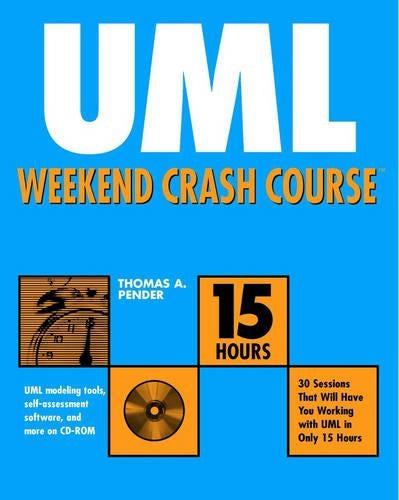
UML Weekend Crash Course

UML Weekend Crash Course

Regular price
Checking stock...
Regular price
Checking stock...
Summary

Covers topics such as: What is the UML? UML and Development Methodologies, How to Approach the UML, and, Defining Requirements for the Case Study; Understanding the Use Case Model, Building the Use Case Diagram, Building the Use Case Narrative, Identifying the Use Case Scenarios, Modeling the Static View: The Class Diagram, and, more.

The feel-good place to buy books
  • Free US shipping over $15
  • Buying preloved emits 41% less CO2 than new
  • Millions of affordable books
  • Give your books a new home - sell them back to us!

UML Weekend Crash Course by Tom Pender

ABOUT THE TECHNOLOGY What it is: UML (Unified Modeling Language) is a graphical modeling language used to specify, visualize, construct, and document applications and software systems, which are implemented with components and object-oriented programming languages, such as Java, C++, and Visual Basic. UML incorporates the object-oriented community's consensus on core modeling concepts and provides a standard way for developers to communicate the details of system design and development. In addition to object-oriented modeling of applications, UML is also used for business-process modeling, data modeling, and XML modeling. Purpose of modeling: Models for software systems are as important as having a blueprint for a large building, or an outline for a book. Good models enhance communication among project teams and assure architectural soundness. The more complex the software system, the more important it is to have models that accurately describe the system and can be understood by everyone. UML helps provide this via a standard for graphical diagrams. Just like an architect can understand the notations on any blueprint, UML enables software engineers and business managers to understand the design of any software system, even if the original designers have long left the company. Organization behind it: Object Management Group (OMG) (www.omg.org). (UML Resource Page at OMG Web site is www.omg.org/uml.) The OMG produces and maintains the UML standard, an internationally recognized standard. The OMG is an open membership, not-for-profit consortium that produces and maintains computer industry specifications for interoperable enterprise applications. Its membership roster (about 800) includes just about every large company in the computer industry and hundreds of smaller ones. Most of the companies that shape enterprise and Internet computing are represented on the OMG's Board of Directors. Companies that contributed to the UML Standard: Realizing that UML would be strategic to their business, the following companies contributed their ideas to the first UML standard: Digital Equipment Corp, HP, i-Logix, IntelliCorp, IBM, ICON Computing, MCI, Microsoft, Oracle, Rational Rose, TI, and Unisys. Companies that use UML: It is safe to say that all Fortune 1000 companies are currently using UML, or are moving toward UML to model and design their applications and systems. This includes companies from all vertical industries, from Coca Cola to Warner Brothers, from CVS Pharmacy to Lockhead Martin Aerospace. You name the company - if they have an IT department, they are using UML.
"..well-written...I would recommend it..." (Cvu, February 2003)
Thomas A. Pender (Reno, NV) is the author of six courses on UML. He has taught throughout the United States and in 12 other countries and has over 20 years of systems development experience in various industries. Tom has spent the past four years providing teaching and consulting services to companies that are transitioning to object-oriented technologies.
SKU Unavailable
ISBN 13 9780764549106
ISBN 10 0764549103
Title UML Weekend Crash Course
Author Tom Pender
Series Weekend Crash Course
Condition Unavailable
Binding Type Paperback
Publisher John Wiley & Sons Inc
Year published 2002-07-15
Number of pages 384
Cover note Book picture is for illustrative purposes only, actual binding, cover or edition may vary.
Note Unavailable