
Understanding Greek Tragic Theatre


World of Books
The feel-good place to buy books
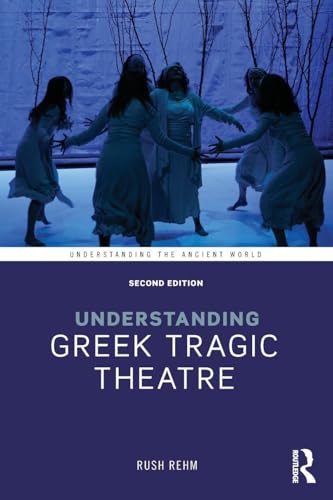
Understanding Greek Tragic Theatre by Rush Rehm
Understanding Greek Tragic Theatre, a revised edition of Greek Tragic Theatre (1992), is intended for those interested in how Greek tragedy works. By analysing the way the plays were performed in fifth-century Athens, Rush Rehm encourages classicists, actors, and directors to approach Greek tragedy by considering its original context. Emphasizing the political nature of tragedy as a theatre of, by, and for the polis, Rehm characterizes Athens as a performance culture, one in which the theatre stood alongside other public forums as a place to confront matters of import and moment. In treating the various social, religious and practical aspects of tragic production, he shows how these elements promoted a vision of the theatre as integral to the life of the city – a theatre whose focus was on the audience. The second half of the book examines four exemplary plays, Aeschylus’ Oresteia trilogy, Sophocles’ Oedipus Tyrannus, and Euripides’ Suppliant Women and Ion. Without ignoring the scholarly tradition, Rehm focuses on how each tragedy unfolds in performance, generating different relationships between the characters (and chorus) on stage and the audience in the theatre."As a classicist and theater director, Rehm (Stanford) is well suited to offer an insightful analysis of Greek tragedy that emphasizes aspects of performanceIn this second edition of Greek Tragic Theatre (CH, Mar'93, 30-3724), the author offers limited changes: though the notes have been thoroughly updated, the sections and chapter titles are identical in both editions."
- S. E. Goins, McNeese State University
"This new edition will be a great resource – and an enjoyable read – for anyone interested in Greek tragic theatre. As both scholar and actor/director, Rush Rehm knows the right questions to ask, and his answers are richly informative and thought-provoking."
- Pat Easterling, University of Cambridge, UK
"As a classicist and theater director, Rehm is well suited to offer an insightful analysis of Greek tragedy that emphasizes aspects of performance. In this second edition of Understanding Greek Tragic Theatre, the author offers limited changes: though the notes have been thoroughly updated, the sections and chapter titles are identical in both editions."
- S. E. Goins, McNeese State University, USA, CHOICE review
"In a thriving time of general introductions on Greek tragedy, Rehm’s Understanding Greek Tragic Theatre stands out as a non-conventional account of tragic theatre, making it lively reading for scholars and students alike. In this volume, Rehm presents a coherent and fascinating reading of Athenian tragedy and theatre as part and parcel of a "performance culture", a working definition that Rehm had the merit to put to good use before, as he reminds his readers, it became a cliché on fifth-century Athens ... Rehm offers a fresh and engaged look at the dynamics of Athenian tragic theatre."
- Manuela Giordano, Università della Calabria, Italy, Bryn Mawr Classical Review 2018
| SKU | Unavailable |
| ISBN 13 | 9781138812628 |
| ISBN 10 | 1138812625 |
| Title | Understanding Greek Tragic Theatre |
| Author | Rush Rehm |
| Series | Understanding The Ancient World |
| Condition | Unavailable |
| Binding Type | Paperback |
| Publisher | Taylor & Francis Ltd |
| Year published | 2016-07-13 |
| Number of pages | 174 |
| Cover note | Book picture is for illustrative purposes only, actual binding, cover or edition may vary. |
| Note | Unavailable |