


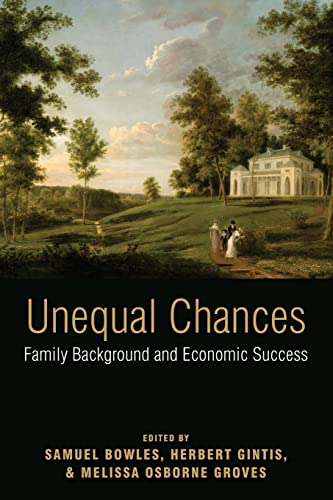
Unequal Chances by Samuel Bowles
Is the United States "the land of equal opportunity" or is the playing field tilted in favor of those whose parents are wealthy, well educated, and white? If family background is important in getting ahead, why? And if the processes that transmit economic status from parent to child are unfair, could public policy address the problem? Unequal Chances provides new answers to these questions by leading economists, sociologists, biologists, behavioral geneticists, and philosophers. New estimates show that intergenerational inequality in the United States is far greater than was previously thought. Moreover, while the inheritance of wealth and the better schooling typically enjoyed by the children of the well-to-do contribute to this process, these two standard explanations fail to explain the extent of intergenerational status transmission. The genetic inheritance of IQ is even less important. Instead, parent-offspring similarities in personality and behavior may play an important role. Race contributes to the process, and the intergenerational mobility patterns of African Americans and European Americans differ substantially. Following the editors' introduction are chapters by Greg Duncan, Ariel Kalil, Susan E. Mayer, Robin Tepper, and Monique R. Payne; Bhashkar Mazumder; David J. Harding, Christopher Jencks, Leonard M. Lopoo, and Susan E. Mayer; Anders Bjorklund, Markus Jantti, and Gary Solon; Tom Hertz; John C. Loehlin; Melissa Osborne Groves; Marcus W. Feldman, Shuzhuo Li, Nan Li, Shripad Tuljapurkar, and Xiaoyi Jin; and Adam Swift.
"An impressive book.. [T]he book includes a heavy dose of philosophy about social justice and what part the family plays in creating, sustaining, or advancing economic advantage, to the loss and gain of other families."--Larry Nackerud, Journal of Sociology and Social Welfare
Samuel Bowles is Research Professor and director of the Behavioral Sciences Program at the Santa Fe Institute, and professor of Economics at the University of Siena. He is the author of "Microeconomics" (Princeton); the coauthor, with Herbert Gintis, of "Democracy and Capitalism"; and the coeditor, with Kenneth Arrow and Steven Durlauf, of "Meritocracy and Inequality" (Princeton). Herbert Gintis is an external faculty member at the Santa Fe Institute and professor emeritus of economics at the University of Massachusetts, Amherst. He is the author of "Game Theory Evolving" (Princeton). Melissa Osborne Groves is associate professor of economics at Towson University.
| SKU | Unavailable |
| ISBN 13 | 9780691136202 |
| ISBN 10 | 0691136203 |
| Title | Unequal Chances |
| Author | Samuel Bowles |
| Condition | Unavailable |
| Binding Type | Paperback |
| Publisher | Princeton University Press |
| Year published | 2008-01-23 |
| Number of pages | 304 |
| Cover note | Book picture is for illustrative purposes only, actual binding, cover or edition may vary. |
| Note | Unavailable |