
US-Spanish Relations after Franco, 1975-1989


Summary
The feel-good place to buy books
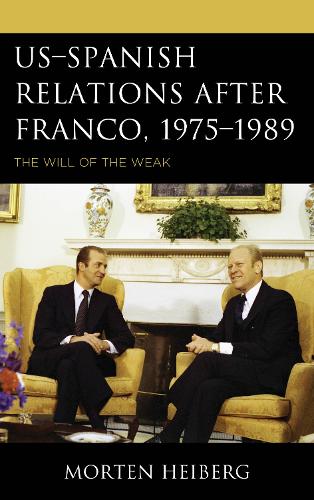
US-Spanish Relations after Franco, 1975-1989 by Morten Heiberg
On September 26, 1953, the Eisenhower administration signed three executive agreements with General Franco's regime, which allowed the United States to install military bases in Spain in exchange for economic and military aid. The deal clearly favored US Cold War interests, and critics soon denounced that by signing the Pact of Madrid America had betrayed its own democratic credentials. The agreements stabilized the dictatorship and effectively converted it into a US satellite. During the transition to democracy after 1975, the US military presence in Spain was strongly debated. Many politicians and a large section of the Spanish public demanded a new foreign policy and a much higher degree of autonomy for Spain in the international system. However, as this book unravels, the UCD center governments of the late 1970s and early 1980s essentially gave up on their long-held claim to a new and more balanced relationship with Washington. This fact was carefully concealed from the public. Thus, it was only well into the mid-1980s, when the new socialist government gradually developed a more consistent foreign policy doctrine, that Washington fully realized that the bilateral relations had to be approached in an entirely different manner. For all these reasons, the present work is also a statement in the ongoing scholarly debate on the Spanish transition to democracy and the importance of foreign influences on this process. Finally, the book sheds new light on the role of King Juan Carlos in foreign affairs, just as it discusses Spain's alleged role in the Iran-Contra Affair.
To what extent does history weigh on the actual making of foreign policy? Morten Heiberg provides an answer by examining US–Spanish relations from the dark days of Franco to democratic Spain´s coming of age under the government of Felipe GonzálezThis is a sharply written, cutting-edge analysis of the difficulties that had to be surmounted in order to rebalance the bilateral security link. The best account available in English, this is an essential study which will not leave any reader indifferent. -- Angel Viñas, Complutense University of Madrid
This study provides an impressive, unprecedented, and fascinating narrative of the Spanish–US relationship. Morten Heiberg’s book takes readers from Franco’s submission to the recovery of Spanish sovereignty. The book discloses many unknown aspects of the negotiation process during Spain’s first democratic governments. It enhances the major role of His Majesty King Juan Carlos. But above all it extracts a universal conclusion: the ‘weak’ can win the battle if they are determined and well-guided, because weakness is their strength. -- Miguel Ángel Moratinos, Sciences Po, and former foreign minister of Spain (2004–2010)
In this lucidly written account of relations between Spain and the United States during the transitional period from the dictatorship of General Franco to the integration of democratic Spain into Europe, Morten Heiberg convincingly argues that the domestic political evolution of the perceptions of Spanish foreign policymakers was closely connected to the status of US relations. Heiberg, who gained access to previously classified Spanish and American documents, demonstrates that post-Franco policymakers were influenced by the Spanish collective memory of being humiliated by the emerging world power in the Spanish–American war of 1898, until Spain was, in reality, reduced to a status as US client after the base agreements of 1953. After Franco’s death in 1975, the new Spanish leadership sought to achieve territorial integrity and greater autonomy through the revisions of the US base agreements. Heiberg’s fascinating narrative of the Spanish–American negotiations until 1988, which eventually improved relations between the two nations and paved the way for Spain’s integration into Europe, contains much new information—and his description of King Juan Carlos’s active role behind the scenes is bound to attract attention. -- Regin Schmidt, University of Copenhagen
Based on a vast amount of sources, Morten Heiberg aptly analyzes how the transition to democracy after 1975 influenced US–Spanish relations. The author highlights the crucial role Felipe González played in formulating a foreign policy strategy that, for the first time since 1898, safeguarded Spanish national interests vis-à-vis the United States. Unlike Franco, the socialist president succeeded in putting his country on an equal footing with the United States. -- Bernd Rother, The Federal Chancellor Willy Brandt Foundation
This study provides an impressive, unprecedented, and fascinating narrative of the Spanish–US relationship. Morten Heiberg’s book takes readers from Franco’s submission to the recovery of Spanish sovereignty. The book discloses many unknown aspects of the negotiation process during Spain’s first democratic governments. It enhances the major role of His Majesty King Juan Carlos. But above all it extracts a universal conclusion: the ‘weak’ can win the battle if they are determined and well-guided, because weakness is their strength. -- Miguel Ángel Moratinos, Sciences Po, and former foreign minister of Spain (2004–2010)
In this lucidly written account of relations between Spain and the United States during the transitional period from the dictatorship of General Franco to the integration of democratic Spain into Europe, Morten Heiberg convincingly argues that the domestic political evolution of the perceptions of Spanish foreign policymakers was closely connected to the status of US relations. Heiberg, who gained access to previously classified Spanish and American documents, demonstrates that post-Franco policymakers were influenced by the Spanish collective memory of being humiliated by the emerging world power in the Spanish–American war of 1898, until Spain was, in reality, reduced to a status as US client after the base agreements of 1953. After Franco’s death in 1975, the new Spanish leadership sought to achieve territorial integrity and greater autonomy through the revisions of the US base agreements. Heiberg’s fascinating narrative of the Spanish–American negotiations until 1988, which eventually improved relations between the two nations and paved the way for Spain’s integration into Europe, contains much new information—and his description of King Juan Carlos’s active role behind the scenes is bound to attract attention. -- Regin Schmidt, University of Copenhagen
Based on a vast amount of sources, Morten Heiberg aptly analyzes how the transition to democracy after 1975 influenced US–Spanish relations. The author highlights the crucial role Felipe González played in formulating a foreign policy strategy that, for the first time since 1898, safeguarded Spanish national interests vis-à-vis the United States. Unlike Franco, the socialist president succeeded in putting his country on an equal footing with the United States. -- Bernd Rother, The Federal Chancellor Willy Brandt Foundation
Morten Heiberg is professor of contemporary Spanish studies at the University of Copenhagen.
| SKU | Unavailable |
| ISBN 13 | 9781498575003 |
| ISBN 10 | 1498575005 |
| Title | US-Spanish Relations after Franco, 1975-1989 |
| Author | Morten Heiberg |
| Series | The Harvard Cold War Studies Book Series |
| Condition | Unavailable |
| Binding Type | Hardback |
| Publisher | Bloomsbury Publishing Plc |
| Year published | 2018-02-19 |
| Number of pages | 242 |
| Cover note | Book picture is for illustrative purposes only, actual binding, cover or edition may vary. |
| Note | Unavailable |