


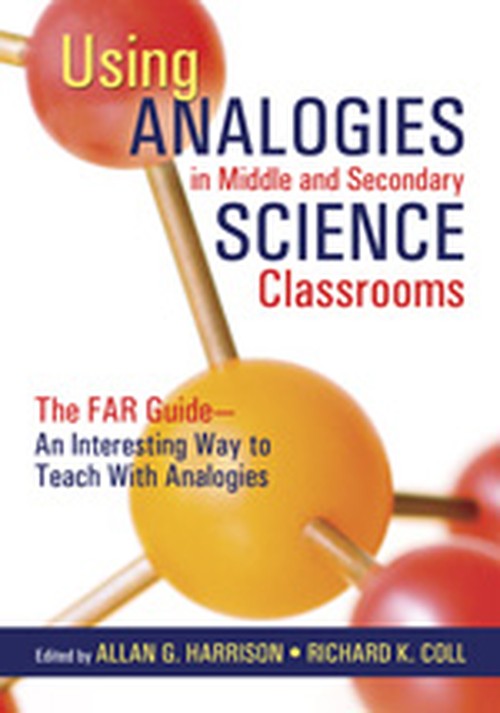
Using Analogies in Middle and Secondary Science Classrooms by Allan G Harrison
Offers more than 40 teacher-friendly, ready-to-use analogies for science classrooms and shows teachers how to select analogies for instruction, gauge their impact, and improve their effectiveness.
"We need a book to help preservice and novice teachers use analogies and this resource allows teachers to bridge the gap that sometimes occurs when students are learning abstract conceptsThe examples cover a wide variety of subjects and are written in a concise, easy-to-understand voice." -- John D. Ophus, Assistant Professor of Science Education
"This book will make a definite contribution to the teaching of science." -- Sara Lynne Murrell, Instructional Coach
"Makes a distinct contribution to science instruction. Many teachers attempt to use analogies and metaphors to introduce abstract concepts; however, little is offered on how to do this with specific examples. The authors definitely address a need."
-- Douglas Llewellyn, Professor of Science Education
"The book has great potential for promoting thinking and understanding in science. It should be useful to teachers and students in strengthening conceptual and content background." -- Sandra K. Enger, Associate Professor
"The authors explain that scientists use analogies regularly in their research and writing. Analogies such as a supermarket for the biological classification system and a school dance for chemical equilibrium are discussed for their individual effectiveness in stimulating learning." -- CHOICE Magazine, June 2008, Vol. 45(10)
"This book will make a definite contribution to the teaching of science." -- Sara Lynne Murrell, Instructional Coach
"Makes a distinct contribution to science instruction. Many teachers attempt to use analogies and metaphors to introduce abstract concepts; however, little is offered on how to do this with specific examples. The authors definitely address a need."
-- Douglas Llewellyn, Professor of Science Education
"The book has great potential for promoting thinking and understanding in science. It should be useful to teachers and students in strengthening conceptual and content background." -- Sandra K. Enger, Associate Professor
"The authors explain that scientists use analogies regularly in their research and writing. Analogies such as a supermarket for the biological classification system and a school dance for chemical equilibrium are discussed for their individual effectiveness in stimulating learning." -- CHOICE Magazine, June 2008, Vol. 45(10)
Allan G. Harrison is Associate Professor of Science Education at Central Queensland University. Allan taught biology, chemistry and physics to students in Grades 7-12 for 25 years before completing his MSc and PhD at Curtin University of Technology in Perth, Western Australia. He has taught science teachers for 10 years and has researched teaching and learning with analogies for 15 years and published articles on science analogies in all leading science education journals. Allan also studies the capacity of analogies to engender conceptual change. He brings to this book his personal practical experience in teaching with analogies in high school and his research on other teachers’ use of analogies. He believes that analogies, when used well, enhance students’ interest and knowledge in science. He hopes you will share with him his commitment to learning for understanding. Richard K. Coll is associate professor of science education at the University of Waikato, New Zealand. Richard holds a PhD in chemistry from Canterbury University and an EdD in science education from Curtin University of Technology. His research interests are concerned with mental models of science concepts, and a variety of aspects of work-integrated learning.
| SKU | Unavailable |
| ISBN 13 | 9781412913331 |
| ISBN 10 | 1412913330 |
| Title | Using Analogies in Middle and Secondary Science Classrooms |
| Author | Allan G Harrison |
| Condition | Unavailable |
| Binding Type | Paperback |
| Publisher | SAGE Publications Inc |
| Year published | 2008-01-15 |
| Number of pages | 288 |
| Cover note | Book picture is for illustrative purposes only, actual binding, cover or edition may vary. |
| Note | Unavailable |