


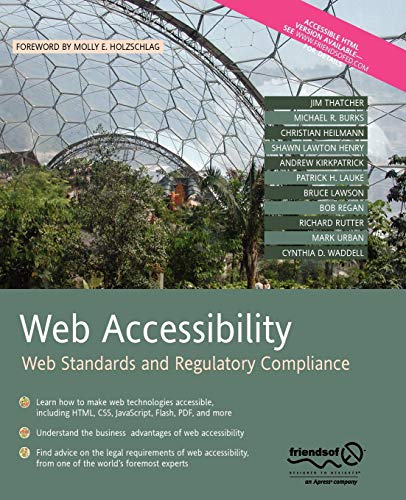
Web Accessibility by Richard Rutter
The Challenge of Accessibility When Tim Berners-Lee created the Web, he had some very specific goals in mind. Certainly, creating a technology that allowed the sharing of information was a main part of that goal, but an interesting piece of Berners-Lee's vision has always had to do with the human side of the Web. After all, it's not machines that use the Web, but people. Accessibility has become a hot topic in web design, despite the fact that it has always been a part of the original vision. In a broad sense, accessibility simply means ensuring that a given page on the Web is able to be accessed. Accessibility is not about disability; rather, it's about people getting to the shared information that the vision of the Web has made manifest. There has also been a lot said about how accessibility relates to web standards and vice versa. Realistically, accessibility relies on aspects of related web standards, but has in fact become a science, art, and practice of its own. It's a deep specialty, and one that is highly problematic, as what might make a page accessible to one person could conceivably render it inaccessible to another.
Richard Rutter lives and works in Brighton, U.K. He is production director for the web consultancy Clearleft (www.clearleft.com). Richard has been designing and developing websites for nigh on 10 years. Early in 2003, he built his first blogging engine, which still powers his weblog Clagnut (www.clagnut.com), in which he harps on about accessibility, web standards, and mountain biking.
| SKU | Unavailable |
| ISBN 13 | 9781590596388 |
| ISBN 10 | 1590596382 |
| Title | Web Accessibility |
| Author | Richard Rutter |
| Condition | Unavailable |
| Binding Type | Paperback |
| Publisher | APress |
| Year published | 2006-07-25 |
| Number of pages | 696 |
| Cover note | Book picture is for illustrative purposes only, actual binding, cover or edition may vary. |
| Note | Unavailable |