
Welfare, Modernity, and the Weimar State


Summary
The feel-good place to buy books
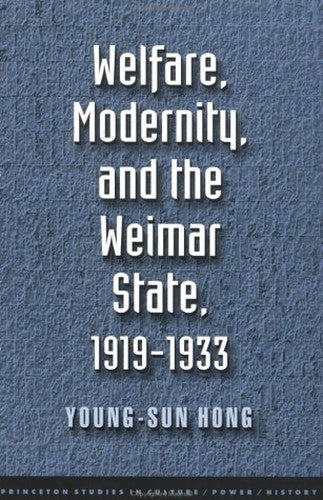
Welfare, Modernity, and the Weimar State by Young-Sun Hong
This is the first comprehensive study of the turbulent relationship among state, society, and church in the making of the modern German welfare system during the Weimar Republic. Young-Sun Hong examines the competing conceptions of poverty, citizenship, family, and authority held by the state bureaucracy, socialists, bourgeois feminists, and the major religious and humanitarian welfare organizations. She shows how these conceptions reflected and generated bitter conflict in German society. And she argues that this conflict undermined parliamentary government within the welfare sector in a way that paralleled the crisis of the entire Weimar political system and created a situation in which the Nazi critique of republican "welfare" could acquire broad political resonance. The book begins by tracing the transformation of Germany's traditional, disciplinary poor-relief programs into a modern, bureaucratized and professionalized social welfare system. It then shows how, in the second half of the republic, attempts by both public and voluntary welfare organizations to reduce social insecurity by rationalizing working-class family life and reproduction alienated welfare reformers and recipients alike from both the welfare system and the Republic itself. Hong concludes that, in the welfare sector, the most direct continuity between the republican welfare system and the social policies of Nazi Germany is to be found not in the pathologies of progressive social engineering, but rather in the rejection of the moral and political foundations of the republican welfare system by eugenic welfare reformers and their Nazi supporters.
Hong, Young-Sun: - Young-sun Hong is Associate Professor of History at the State University of New York at Stony Brook and the author of Welfare, Modernity and the Weimar State, 1919-1933 (1998). She has been a Fellow at the Woodrow Wilson International Center for Scholars, the Harvard Center for European Studies, and New York University's International Center for Advanced Studies. She has also received fellowships from the German Marshall Fund, the Max-Planck Institute, the German Academic Exchange Service, and the Social Science Research Council. Hong has contributed to debates on modernity and transnationalism at the H-German Forum on Transnationalism (2006) and the German History Forum on Asia, Germany and the Transnational Turn (2010). In 2008, she organized a session on Asian-German studies at the German Studies Association meeting. Currently, she serves on the editorial board of Social History.
| SKU | Unavailable |
| ISBN 13 | 9780691057934 |
| ISBN 10 | 0691057931 |
| Title | Welfare, Modernity, and the Weimar State |
| Author | Young-Sun Hong |
| Series | Princeton Legacy Library |
| Condition | Unavailable |
| Binding Type | Paperback |
| Publisher | Princeton University Press |
| Year published | 1998-04-26 |
| Number of pages | 320 |
| Cover note | Book picture is for illustrative purposes only, actual binding, cover or edition may vary. |
| Note | Unavailable |