
Welfare Reform in Persistent Rural Poverty


Summary
The feel-good place to buy books
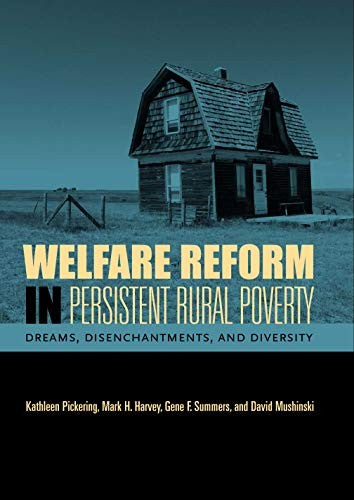
Welfare Reform in Persistent Rural Poverty by Kathleen Pickering
Since the Personal Responsibility and Work Opportunity Reconciliation Act of 1996 was enacted, policy makers, agency administrators, community activists, and academics from a broad range of disciplines have debated and researched the implications of welfare reform in the United States. Most of the attention, however, has focused on urban rather than rural America. Welfare Reform in Persistent Rural Poverty examines welfare participants who live in chronically poor rural areas of the United States where there are few job opportunities and poor systems of education, transportation, and child care. Kathleen Pickering and her colleagues look at welfare reform as it has been experienced in four rural and impoverished regions of the United States: American Indian reservations in South Dakota, the Rio Grande region, Appalachian Kentucky, and the Mississippi Delta. Throughout these areas the rhetoric of reform created expectations of new opportunities to find decent work and receive education and training. In fact, these expectations have largely gone unfulfilled as welfare reform has failed to penetrate poor areas where low-income families remain isolated from the economic and social mainstream of American society. Welfare Reform in Persistent Rural Poverty sheds welcome light on the opportunities and challenges that welfare reform has imposed on low-income families situated in disadvantaged areas. Combining both qualitative and quantitative research, it will be an excellent guide for scholars and practitioners alike seeking to address the problem of poverty in rural America.“Rural poverty has been seriously neglected by scholars, making this book particularly welcomeIt is balanced, well written, and focused on a timely issue. It should be of interest to social workers and a broad array of social scientists.”
—S. Pressman Choice
“The authors successfully make the case that there is more to the story of welfare reform than simply declining caseloads, and there are many lessons to be learned for researchers and policymakers. If you are interested in a broad treatment of the effects of welfare reform in persistently poor rural counties, this book is not for you. However, if you are interested in an analysis, rich in local context, of how welfare reform worked in some of the poorest rural counties in the United States, then it will be a great addition to your library.”
—Alexander Marré Journal of Regional Science
“Welfare Reform in Persistent Rural Poverty is a welcome addition to the literature on welfare reform and required reading for anyone seeking to decipher the local consequences of the 1997 legislation.”
—Julie Zimmerman American Journal of Sociology
Kathleen Pickering is Professor of Anthropology at Colorado State University.
Mark H. Harvey is Assistant Professor of Sociology at Florida Atlantic University.
Gene F. Summers is Professor Emeritus of Rural Sociology at the University of Wisconsin–Madison.
David Mushinski is Associate Professor of Economics at Colorado State University.
| SKU | Unavailable |
| ISBN 13 | 9780271028781 |
| ISBN 10 | 0271028785 |
| Title | Welfare Reform in Persistent Rural Poverty |
| Author | Kathleen Pickering |
| Series | Rural Studies |
| Condition | Unavailable |
| Binding Type | Paperback |
| Publisher | Pennsylvania State University Press |
| Year published | 2011-11-15 |
| Number of pages | 256 |
| Cover note | Book picture is for illustrative purposes only, actual binding, cover or edition may vary. |
| Note | Unavailable |