
The West Indies: Patterns of Development, Culture and Environmental Change since 1492


Summary
The feel-good place to buy books
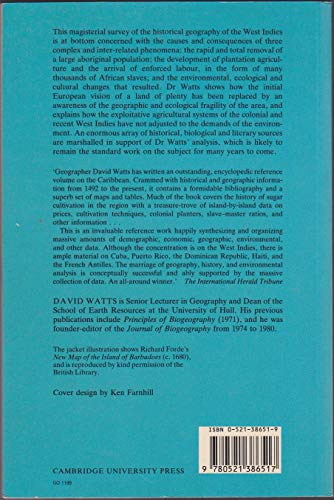
The West Indies: Patterns of Development, Culture and Environmental Change since 1492 by David Watts
This magisterial survey of the historical geography of the West Indies is at bottom concerned with the causes and consequences of three complex and inter-related phenomena: the rapid and total removal of a large aboriginal population; the development of plantation agriculture and the arrival of enforced labour, in the form of many thousands of African slaves; and the environmental, ecological and cultural changes that resulted. Dr Watts shows how the initial European vision of a land of plenty has been replaced by an awareness of the geographic and ecological fragiliaty of the area, and explains how the exploitative agricultural systems of the colonial and recent West Indies have not adjusted to the demands of the environment. An enormous array of historical, biological and literary sources are marshalled in support of Dr Watts' analysis, which is likely to remain the standard work on the subject for many years to come.
"A well-known British biographer has collected from original fieldwork and intensive library research a wide range of detailed historical and environmental material about the Caribbean islands, from their earliest occupation to the presentInevitably, the principal theme is sugar and how it influenced not only the islands but the policies of the colonial powers for more than 300 years. Just as important are the consequences for each pristine island environment of introducing successions of foreign plants and animals. A nearly flawless text...is supplemented by a large number of well-constructed maps, tables, and model diagrams." Choice
"...[Watts] takes as his subject a region where the impact of Europeans on nature was particularly marked, both because they encountered a fragile ecology, and because at first they focused their rapaciousness on just a few islands. The resulting book, The West Indies, demonstrates impressively the potential of environmental history." Times Literary Supplement
"David Watts has managed to capture both the complexity and the simplicity of Caribbean development and weave them together in a remarkable study that covers the region as a whole over the entire span of its modern history." Dale W. Tomich, Forest & Conservation History
"...[Watts] takes as his subject a region where the impact of Europeans on nature was particularly marked, both because they encountered a fragile ecology, and because at first they focused their rapaciousness on just a few islands. The resulting book, The West Indies, demonstrates impressively the potential of environmental history." Times Literary Supplement
"David Watts has managed to capture both the complexity and the simplicity of Caribbean development and weave them together in a remarkable study that covers the region as a whole over the entire span of its modern history." Dale W. Tomich, Forest & Conservation History
David Watts is a San Francisco-based physician. He is the author of Bedside Manners: One Doctor's Thoughts on the Strangely Personal Meetings between Patient and Healer, Blessing, Creating, Taking the History, and Slow Walking at Jenner-by-the-Sea. He is also a poet, musician, television host, and teacher. In the summer of 2008, he produced Healing Words: Poetry and the Art of Medicine, which aired nationally on PBS.
| SKU | Unavailable |
| ISBN 13 | 9780521386517 |
| ISBN 10 | 0521386519 |
| Title | The West Indies: Patterns of Development, Culture and Environmental Change since 1492 |
| Author | David Watts |
| Series | Cambridge Studies In Historical Geography |
| Condition | Unavailable |
| Binding Type | Paperback |
| Publisher | Cambridge University Press |
| Year published | 1990-03-22 |
| Number of pages | 640 |
| Cover note | Book picture is for illustrative purposes only, actual binding, cover or edition may vary. |
| Note | Unavailable |