


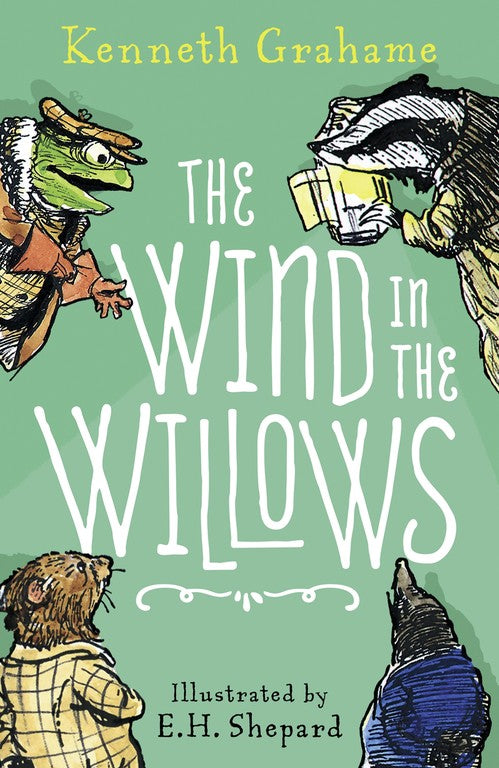
The Wind in the Willows by Kenneth Grahame
Friedrich Nietzsche's philosophical work Beyond Good and Evil questions conventional morality and intellectual assumptions. According to Nietzsche, conventional morality, which is founded on cultural and religious conventions, is constrictive and inhibits people from completely expressing who they really are. According to Nietzsche's will to power theory, people naturally want to use their power and influence to influence others. He also presents the notion of the superman, a mythical being free to choose their own moral standards and transcend conventional morality. Nietzsche criticises standard philosophical notions like the concept of truth and the notion of free will throughout the whole book. He contends that reality is relative and dependent on one's viewpoint, and that free will is an illusion produced by our need for control. While Beyond Good and Evil is difficult to read, it is nonetheless a significant contribution to contemporary philosophy. It inspires people to reconsider their convictions and look for a more genuine and satisfying existence outside of conventional cultural conventions.Kenneth Grahame was born in 1859. He grew up in Cookham Dene, Berkshire, in an idealised country cottage. Water meadows ran down to the River Thames; his passion for rivers can be seen in The Wind in the Willows. Kenneth went to school at St Edward’s, Oxford. Prevented for family reasons from continuing on to university, he became a clerk at the Bank of England. By 1879 he belonged to several literary societies, and was writing pieces for papers, including the National Observer. A collection of his magazine articles were published in 1893: Pagan Papers. In 1898 he became Secretary to the Bank of England. Soon after, in 1899, he married Elspeth Thomson. Their son Alastair was born in 1900. It was on the evening of his fourth birthday that Kenneth Grahame first told his son a story about moles and water rats. This story was continued over the next three years, but it was only when Constance Smedley suggested that he make a book out of it that it took shape as The Wind in the Willows, and published by Methuen. The book was published on 8 October 1908. In 1931 Ernest H Shephard was asked to illustrate it, following his success with the illustrations in Winnie-the-Pooh. In 1908 Kenneth Grahame retired before moving to Pangbourne in 1924 where he lived until his death in 1932.
| SKU | Unavailable |
| ISBN 13 | 9781405237307 |
| ISBN 10 | 1405237309 |
| Title | The Wind in the Willows |
| Author | Kenneth Grahame |
| Condition | Unavailable |
| Binding Type | Paperback |
| Publisher | HarperCollins Publishers |
| Year published | 2008-02-04 |
| Number of pages | 272 |
| Cover note | Book picture is for illustrative purposes only, actual binding, cover or edition may vary. |
| Note | Unavailable |