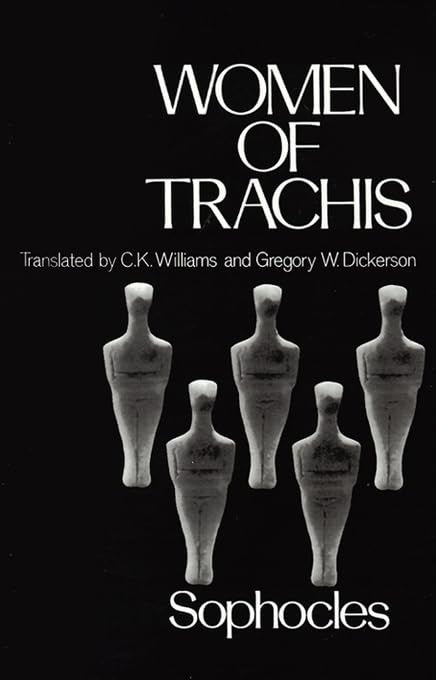
Women of Trachis by Sophocles
Trachiniae, also known as Women of Trachis, is an Athenian tragedy by Sophocles. Sophocles or Sofokles (c496BC-c406BC) was the second of the three ancient Greek tragedians whose work has survived to the present day. His first plays were written later than those of Aeschylus, and earlier than those of Euripides. According to the Suda, a 10th century encyclopedia, Sophocles wrote 120 or more plays during the course of his life, but only seven have survived in a complete form, namely Ajax, Antigone, Trachinian Women, Oedipus the King, Electra, Philoctetes and Oedipus at Colonus. For almost 50 years, Sophocles was the most-awarded playwright in the dramatic competitions of ancient Athens that took place during the religious festivals of the Lenaea and the Dionysia. Sophocles competed in around thirty drama competitions; he won perhaps twenty four and never received lower than second place. Aeschylus won fourteen competitions and was defeated by Sophocles at times. The most famous of Sophocles's tragedies are those concerning Oedipus and Antigone: these are often known as the Theban Plays or The Oedipus Cycle, although each play was actually a part of a different trilogy, the other members of which are now lost.
Sophocles was born at Colonus, just outside Athens, in 496 BC, and lived ninety years. His long life spanned the rise and decline of the Athenian Empire; he was a friend of Pericles, and though not an active politician he held several public offices, both military and civil. The leader of a literary circle and friend of Herodotus, he was interested in poetic theory as well as practice, and he wrote a prose treatise On the Chorus. He seems to have been content to spend all his life at Athens, and is said to have refused several invitations to royal courts.Sophocles first won a prize for tragic drama in 468, defeating the veteran Aeschylus. He wrote over a hundred plays for the Athenian theater, and is said to have come first in twenty-four contests. Only seven of his tragedies are now extant, these being Ajax, Antigone, Oedipus the King, Women of Trachis, Electra, Philoctetes, and the posthumous Oedipus at Colonus. A substantial part of The Searches, a satyr play, was recovered from papyri in Egypt in modern times. Fragments of other plays remain, showing that he drew on a wide range of themes; he also introduced the innovation of a third actor in his tragedies. He died in 406 BC. Robert Fagles (1933-2008) was Arthur W. Marks '19 Professor of Comparative Literature, Emeritus, at Princeton University. He was the recipient of the 1997 PEN/Ralph Manheim Medal for Translation and a 1996 Award in Literature from the American Academy of Arts and Letters. His translations include Sophocles's Three Theban Plays, Aeschylus's Oresteia (nominated for a National Book Award), Homer's Iliad (winner of the 1991 Harold Morton Landon Translation Award by The Academy of American Poets), Homer's Odyssey, and Virgil's Aeneid. Bernard Knox (1914-2010) was Director Emeritus of Harvard's Center for Hellenic Studies in Washington, D.C. He taught at Yale University for many years. Among his numerous honors are awards from the National Institute of Arts and Letters and the National Endowment for the Humanities. His works include The Heroic Temper: Studies in Sophoclean Tragedy, Oedipus at Thebes: Sophocles' Tragic Hero and His Time and Essays Ancient and Modern (awarded the 1989 PEN/Spielvogel-Diamonstein Award).
| SKU | Unavailable |
| ISBN 13 | 9780195070095 |
| ISBN 10 | 0195070097 |
| Title | Women of Trachis |
| Author | Sophocles |
| Condition | Unavailable |
| Binding Type | Paperback |
| Publisher | Oxford University Press Inc |
| Year published | 1991-04-25 |
| Number of pages | 112 |
| Cover note | Book picture is for illustrative purposes only, actual binding, cover or edition may vary. |
| Note | Unavailable |