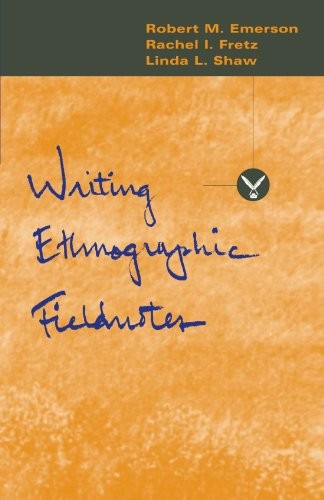
Writing Ethnographic Fieldnotes by Robert M Emerson

Writing Ethnographic Fieldnotes by Robert M Emerson

Regular price
Checking stock...
Regular price
Checking stock...
Summary

This volume demonstrates how the ethnographer turns direct experience and observation into written fieldnotes upon which an ethnography is based. The authors develop a series of guidelines, suggestions and practical advice about how to write useful fieldnotes in a variety of settings.

The feel-good place to buy books
  • Free US shipping over $15
  • Buying preloved emits 41% less CO2 than new
  • Millions of affordable books
  • Give your books a new home - sell them back to us!

Writing Ethnographic Fieldnotes by Robert M Emerson

In this companion volume to John van Maanen's "Tales of the Field", three scholars reveal how the ethnographer turns direct experience and observation into written fieldnotes upon which an ethnography is based. Drawing on years of teaching and field research experience, the authors develop a series of guidelines, suggestions and practical advice about how to write useful fieldnotes in a variety of settings, both cultural and institutional. Using actual, unfinished "working" notes as examples, they illustrate options for composing, reviewing and working fieldnotes into finished texts. They discuss different organizational and descriptive strategies, including evocation of sensory detail, synthesis of complete scenes, the value of partial versus omniscient perspectives and of first-person versus third-person accounts. Of particular interest is the authors' discussion of notetaking as a mindset. They show how transforming direct observations into vivid descriptions results not simply from good memory but more crucially from learning to envision scenes as written. A good ethnographer, they argue, must learn to remember dialogue and movement like an actor, to see colours and shapes like a painter, and to sense moods and rhythms like a poet. The authors also emphasize the ethnographer's core interest in presenting the perceptions and meanings which the people studied attach to their own actions. They demonstrate the subtle ways that writers can make the voices of people heard in the texts they produce. Finally, they analyze the "processing" of fieldnotes - the practice of coding notes to identify themes and methods for selecting and weaving together fieldnote excerpts to write a polished ethnography. This book, however, is more than a "how-to" manual. The authors examine writing fieldnotes as an interactive and interpretive process in which the researcher's own commitments and relationships with those in the field inevitably shape the character and content of those fieldnotes. They explore the conscious and unconscious writing choices that produce fieldnote accounts. And they show how the character and content of these fieldnotes inevitably influence the arguments and analyses the ethnographer can make in the final ethnographic tale. This book shows that note-taking is a craft that can be taught. Along with "Tales of the Field" and George Marcus and Michael Fisher's "Anthropology as Cultural Criticism", "Writing Ethnographic Fieldnotes" should provide an essential tool for students and social scientists alike.
Emerson, Robert M.: -

Robert M. Emerson is professor of sociology at the University of California, Los Angeles. He is associate editor of Journal of Contemporary Ethnography, Qualitative Sociology, and Ethnography. He is author of many books and articles and his studies focus on domestic violence, stalking and neighbor disputes and formal, institutional responses to troubles, mainly by criminal justice and mental health systems.

SKU Unavailable
ISBN 13 9780226206813
ISBN 10 0226206815
Title Writing Ethnographic Fieldnotes
Author Robert M Emerson
Series Chicago Guides To Writing Editing And Publishing
Condition Unavailable
Binding Type Paperback
Publisher The University of Chicago Press
Year published 1995-08-15
Number of pages 272
Cover note Book picture is for illustrative purposes only, actual binding, cover or edition may vary.
Note Unavailable