


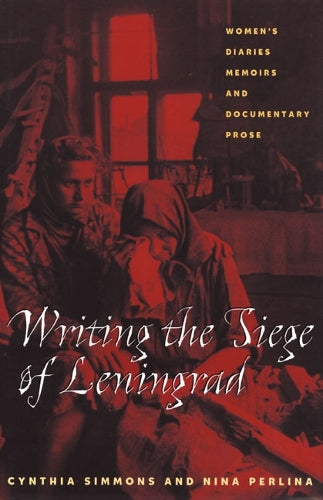
Writing the Siege of Leningrad by Cynthia Simmons
Silver Winner, ForeWord Magazine Book of the Year, History From September 1941 until January 1944, Leningrad suffered under one of the worst sieges in the history of warfare. At least one million civilians died, many during the terribly cold first winter. Bearing the brunt of this hardship—and keeping the city alive through their daily toil and sacrifice—were the women of Leningrad. Yet their perspective on life during the siege has been little examined. Cynthia Simmons and Nina Perlina have searched archival holdings for letters and diaries written during the siege, conducted interviews with survivors, and collected poetry, fiction, and retrospective memoirs written by the blokadnitsy (women survivors) to present a truer picture of the city under siege. In simple, direct, even heartbreaking language, these documents tell of lost husbands, mothers, children; meager rations often supplemented with sawdust and other inedible additives; crime, cruelty, and even cannibalism. They also relate unexpected acts of kindness and generosity; attempts to maintain cultural life through musical and dramatic performances; and provide insight into a group of ordinary women reaching beyond differences in socioeconomic class, ethnicity, and profession in order to survive in extraordinary times.
Stands at the forefront of a new genre of historical literature that strips away the veneer of censorship and propaganda that so dominated historical works of the Soviet era to present a starker and more accurate portrait of Soviet life during World War IIThis inspiring, often depressing, but intensely human portrait of suffering, deprivation, and survival stands as a monument to the resilience of the human spirit." —David M. Glantz, author of The Siege of Leningrad 1941-1944: 900 Days of Terror
"Indispensable for all who take an interest in Russia, its literature, the history of the twentieth century, and women's studies." —Choice
"As historian Richard Bidlack notes in his excellent introduction..., historical literature on the blockade has rarely attempted 'to define female perspectives on the siege and to trace those perspectives through a number of firsthand accounts.' [This] collection of diaries, memoirs, oral histories, and fiction, which focus on the 'small stories' of individual Leningrad women, seeks to fill this void." —Women's Review of Books
"The Siege of Leningrad contains some of the darkest history of World War II. The German Army, unable to complete a direct assault on the city, resorted to a 900-day blockade during which approximately a million civilians died. Most of the men and boys were sacrificed to the war effort, leaving mainly women and children to endure the horrors of extreme deprivation caused by the blockade.... In winter, most citizens lived without heat as temperatures fell to 40 degrees below zero. Grass and leaves, along with glue and anything leather, were the staples of their diet, as all dogs and cats had long ago been eaten. Cannibalism saved many from starving. A very touching account of these women's remarkable accomplishments." —Library Journal
"Indispensable for all who take an interest in Russia, its literature, the history of the twentieth century, and women's studies." —Choice
"As historian Richard Bidlack notes in his excellent introduction..., historical literature on the blockade has rarely attempted 'to define female perspectives on the siege and to trace those perspectives through a number of firsthand accounts.' [This] collection of diaries, memoirs, oral histories, and fiction, which focus on the 'small stories' of individual Leningrad women, seeks to fill this void." —Women's Review of Books
"The Siege of Leningrad contains some of the darkest history of World War II. The German Army, unable to complete a direct assault on the city, resorted to a 900-day blockade during which approximately a million civilians died. Most of the men and boys were sacrificed to the war effort, leaving mainly women and children to endure the horrors of extreme deprivation caused by the blockade.... In winter, most citizens lived without heat as temperatures fell to 40 degrees below zero. Grass and leaves, along with glue and anything leather, were the staples of their diet, as all dogs and cats had long ago been eaten. Cannibalism saved many from starving. A very touching account of these women's remarkable accomplishments." —Library Journal
The Author: Cynthia Simmons is a Visiting Associate Professor in Foreign Languages and Literatures at the Massachusetts Institute of Technology, where she came from the University of Wisconsin-Madison. She received a B.A. from Indiana University and a Ph.D. from Brown University. She is an editor of For Henry Kucera: Studies in Slavic Philology and Computational Linguistics and author of numerous articles on twentieth-century Russian and Croatian literatures and the poetics of discourse.
| SKU | Unavailable |
| ISBN 13 | 9780822958697 |
| ISBN 10 | 0822958694 |
| Title | Writing the Siege of Leningrad |
| Author | Cynthia Simmons |
| Series | Russian And East European Studies |
| Condition | Unavailable |
| Binding Type | Paperback |
| Publisher | University of Pittsburgh Press |
| Year published | 2005-01-19 |
| Number of pages | 288 |
| Cover note | Book picture is for illustrative purposes only, actual binding, cover or edition may vary. |
| Note | Unavailable |