


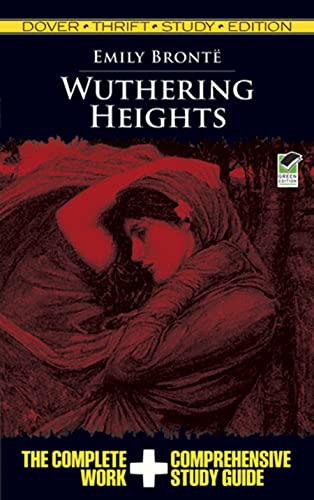
Wuthering Heights by Emily Bronte
While Goethe loved Homeric epic, at the same time, the figure of Homer himself was a source of deep literary anxiety for him. Goethe could translate epic, even masterfully, but he shrunk back from attempting to compose a serious full-length epic of his own. Who could vie with the great nonpareil? he wrote. Reading Wolf's Prolegomena was a significant turning point for Goethe. So greatly had he revered his Homer, that at first, he angrily rejected the idea of an Iliad and Odyssey composed by a succession of illiterate rhapsodes. Gradually, however, with the help of scholarly Weimar friends, he allowed himself to be convinced. Once freed from the idea of a single, monolithic Homer, Goethe experienced a joyous creative rebirth. Why should he not be a rhapsode himself, if only the last of Homer's children? The result was an idyll: Herman und Dorothea, which he adorned with nostalgic love, a hero and heroine on a truly Homeric scale, and a fruitful and thoroughly German landscape. With Hermann und Dorothea, Goethe honored not only Homer, but also his own people and times, celebrating what rhapsodes have always sung: the shadow of war and the love of home.| SKU | Unavailable |
| ISBN 13 | 9780486478036 |
| ISBN 10 | 0486478033 |
| Title | Wuthering Heights |
| Author | Emily Bronte |
| Series | Thrift Editions |
| Condition | Unavailable |
| Binding Type | Paperback |
| Publisher | Dover Publications Inc. |
| Year published | 2010-08-27 |
| Number of pages | 352 |
| Cover note | Book picture is for illustrative purposes only, actual binding, cover or edition may vary. |
| Note | Unavailable |