


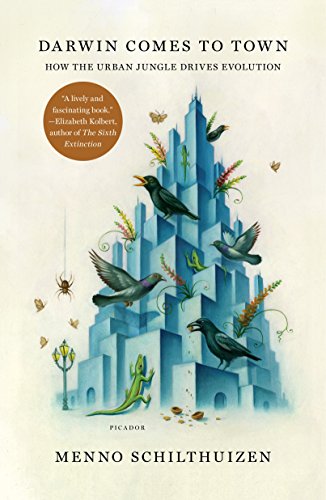
Darwin Comes to Town by Menno Schilthuizen
From evolutionary biologist Menno Schilthuizen, a book that will make you see yourself and the world around you in an entirely new way
*Carrion crows in the Japanese city of Sendai have learned to use passing traffic to crack nuts.
*Lizards in Puerto Rico are evolving feet that better grip surfaces like concrete.
*Europe''s urban blackbirds sing at a higher pitch than their rural cousins, to be heard over the din of traffic.
How is this happening?
Menno Schilthuizen is one of a growing number of "urban ecologists" studying how our manmade environments are accelerating and changing the evolution of the animals and plants around us. In Darwin Comes to Town, he takes us around the world for an up-close look at just how stunningly flexible and swift-moving natural selection can be.
With human populations growing, we''re having an increasing impact on global ecosystems, and nowhere do these impacts overlap as much as they do in cities. The urban environment is about as extreme as it gets, and the wild animals and plants that live side-by-side with us need to adapt to a whole suite of challenging conditions: they must manage in the city''s hotter climate (the "urban heat island"); they need to be able to live either in the semidesert of the tall, rocky, and cavernous structures we call buildings or in the pocket-like oases of city parks (which pose their own dangers, including smog and free-rangingdogs and cats); traffic causes continuous noise, a mist of fine dust particles, and barriers to movement for any animal that cannot fly or burrow; food sources are mainly human-derived. And yet, as Schilthuizen shows, the wildlife sharing these spaces with us is not just surviving, but evolving ways of thriving.
Darwin Comes toTown draws on eye-popping examples of adaptation to share a stunning vision of urban evolution in which humans and wildlife co-exist in a unique harmony. It reveals that evolution can happen far more rapidly than Darwin dreamed, while providing a glimmer of hope that our race toward over population might not take the rest of nature down with us.
Darwin Comes toTown draws on eye-popping examples of adaptation to share a stunning vision of urban evolution in which humans and wildlife co-exist in a unique harmony. It reveals that evolution can happen far more rapidly than Darwin dreamed, while providing a glimmer of hope that our race toward over population might not take the rest of nature down with us.ed, while providing a glimmer of hope that our race toward over population might not take the rest of nature down with us.ironment is about as extreme as it gets, and the wild animals and plants that live side-by-side with us need to adapt to a whole suite of challenging conditions: they must manage in the city''s hotter climate (the "urban heat island"); they need to be able to live either in the semidesert of the tall, rocky, and cavernous structures we call buildings or in the pocket-like oases of city parks (which pose their own dangers, including smog and free-rangingdogs and cats); traffic causes continuous noise, a mist of fine dust particles, and barriers to movement for any animal that cannot fly or burrow; food sources are mainly human-derived. And yet, as Schilthuizen shows, the wildlife sharing these spaces with us is not just surviving, but evolving ways of thriving.
Darwin Comes toTown draws on eye-popping examples of adaptation to share a stunning vision of urban evolution in which humans and wildlife co-exist in a unique harmony. It reveals that evolution can happen far more rapidly than Darwin dreamed, while providing a glimmer of hope that our race toward over population might not take the rest of nature down with us.ironment is about as extreme as it gets, and the wild animals and plants that live side-by-side with us need to adapt to a whole suite of challenging conditions: they must manage in the city''s hotter climate (the "urban heat island"); they need to be able to live either in the semidesert of the tall, rocky, and cavernous structures we call buildings or in the pocket-like oases of city parks (which pose their own dangers, including smog and free-rangingdogs and cats); traffic causes continuous noise, a mist of fine dust particles, and barriers to movement for any animal that cannot fly or burrow; food sources are mainly human-derived. And yet, as Schilthuizen shows, the wildlife sharing these spaces with us is not just surviving, but evolving ways of thriving.
Darwin Comes toTown draws on eye-popping examples of adaptation to share a stunning vision of urban evolution in which humans and wildlife co-exist in a unique harmony. It reveals that evolution can happen far more rapidly than Darwin dreamed, while providing a glimmer of hope that our race toward over population might not take the rest of nature down with us.ed, while providing a glimmer of hope that our race toward over population might not take the rest of nature down with us.ed, while providing a glimmer of hope that our race toward over population might not take the rest of nature down with us.ironment is about as extreme as it gets, and the wild animals and plants that live side-by-side with us need to adapt to a whole suite of challenging conditions: they must manage in the city''s hotter climate (the "urban heat island"); they need to be able to live either in the semidesert of the tall, rocky, and cavernous structures we call buildings or in the pocket-like oases of city parks (which pose their own dangers, including smog and free-rangingdogs and cats); traffic causes continuous noise, a mist of fine dust particles, and barriers to movement for any animal that cannot fly or burrow; food sources are mainly human-derived. And yet, as Schilthuizen shows, the wildlife sharing these spaces with us is not just surviving, but evolving ways of thriving.
Darwin Comes toTown draws on eye-popping examples of adaptation to share a stunning vision of urban evolution in which humans and wildlife co-exist in a unique harmony. It reveals that evolution can happen far more rapidly than Darwin dreamed, while providing a glimmer of hope that our race toward over population might not take the rest of nature down with us.ed, while providing a glimmer of hope that our race toward over population might not take the rest of nature down with us.hich humans and wildlife co-exist in a unique harmony. It reveals that evolution can happen far more rapidly than Darwin dreamed, while providing a glimmer of hope that our race toward over population might not take the rest of nature down with us.ed, while providing a glimmer of hope that our race toward over population might not take the rest of nature down with us.
You might also like
-
 The Madhouse Effect
-
 Life: Our National Parks
-
 Environmental Science: A Global Concern
-
 Principles of Environmental Science Inquiry and Applications
-
 The Wizard and the Prophet
-
 Environmental Science
-
 Pocket Book of Technical Writing for Engineers and Scientists
-
 Eco-Scam
-
 Eco-Scam
-
 Ecology
-
 Introduction to Engineering and the Environment
-
 Environmental Science
-
 Living in the Environment
-
 Uncle John's Presents Blame It on the Weather
-
 Finding Our Niche Hum Role Hea
-
 The Channel Tunnel Story
-
 Environmental Toxicology and Chemistry
-
 An American River
-
 Micro Electro Mechanical System Design
-
 Environmental Science and Engineering
MENNO SCHILTHUIZEN is a professor of evolutionary biology at Leiden University and a senior research scientist at Naturalis Biodiversity Center in the Netherlands. In 1994, he acquired his PhD from Leiden University, went on to Wageningen University for two postdoctoral fellowships, and then spent seven years as an associate professor at the Institute for Tropical Biology and Conservation in Malaysian Borneo. His study focuses on the evolution of biodiversity in insects and land snails, and he has published over 100 high-impact papers on these and other topics in the scientific literature. He is a prolific science popularizer who has published over 250 stories, editorials, and articles for journals such as New Scientist, Time, and Science, in addition to his scientific work. He is the author of Frogs, Flies, and Dandelions (Oxford University Press, 2001), The Loom of Life (Springer, 2008), and Nature's Nether Regions (Viking, 2014). He is a regular guest on radio and television.
| SKU | Unavailable |
| ISBN 13 | 9781250127846 |
| ISBN 10 | 125012784X |
| Title | Darwin Comes to Town |
| Author | Menno Schilthuizen |
| Condition | Unavailable |
| Binding Type | Paperback |
| Publisher | St Martin's Press |
| Year published | 2019-04-02 |
| Number of pages | 304 |
| Cover note | Book picture is for illustrative purposes only, actual binding, cover or edition may vary. |
| Note | Unavailable |