



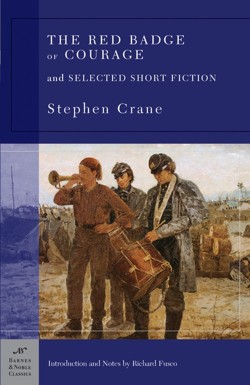
The Red Badge of Courage by Stephen Crane
This internationally acclaimed war novel tells the story of the shame a young private of the Union Army feels after fleeing the battlefield amidst the American Civil War.The Red Badge of Courage is a powerful tale of the American Civil War. The book has garnered international acclaim for its realism and psychological depth in telling the story of a young soldier and his reaction to the horrors of war.
Enriched Classics enhance your engagement by introducing and explaining the historical and cultural significance of the work, the author's personal history, and what impact this book had on subsequent scholarship. Each book includes discussion questions that help clarify and reinforce major themes and reading recommendations for further research.
You might also like
Dubliners
Loading...



Moby Dick
Loading...

The Art Of War
Loading...
The Three Musketeers
Loading...
Ivanhoe
Loading...
Gulliver'S Travels
Loading...
Maggie
Loading...

The Portable Stephen Crane
Loading...



Middlemarch
Loading...


Don Quixote
Loading...

-
 Lame Deer, Seeker of Visions
-
 Oedipus the King
-
 Frankenstein
-
 Great Tales and Poems of Edgar Allan Poe
-
 Les Miserables
-
 Crime and Punishment
-
 The Odyssey
-
 The Metamorphosis
-
 Billy Budd, Sailor
-
 Walden and Civil Disobedience
-
 The Jungle
-
 A Christmas Carol
-
 Bless the Beasts & Children
-
 Cyrano de Bergerac
-
 The Picture of Dorian Gray and Other Writings
-
 Dialogues of Plato
-
 Hard Times
-
 The Virginian
-
 The Scarlet Pimpernel
-
 Dr. Jekyll and Mr. Hyde
-
 Republic
-
 Leaves of Grass
-
 The Awakening and Selected Stories of Kate Chopin
-
 Canterbury Tales
-
 Jane Eyre
-
 The Three Musketeers
-
 The Call of the Wild
-
 The Age of Innocence
-
 Narrative of the Life of Frederick Douglass
-
 Heart of Darkness and the Secret Sharer
-
 Pocket Aristotle
-
 Prince,the:Enriched Classics
-
 Old New York
-
 The Aeneid
-
 Anna Karenina
-
 Moby-Dick
-
 Incidents in the Life of a Slave Girl
-
 Siddhartha
-
 The Importance of Being Earnest and Other Plays
-
 Journey to the Center of the Earth


STEPHEN CRANE was born, the fourteenth child of a Methodist minister, in Newark, New Jersey, on November 1, 1871. Writ-ing was an occupation encouraged in Crane's family; two of his brothers became newspapermen. Crane himself began turning out stories at the age of eight. In 1890, following the deaths of both parents, Crane moved to New York City where, to support himself, he worked as a freelance newspaper writer. His first novel, Maggie: A Girl of the Streets, which Crane had begun at college, was published pseudonymously in 1893, when he was only twenty-one (Crane had had to borrow money from his brother to pay for its initial printing). Reviewers at the time found Maggie, a penetrating look at New York slum life, too cruel, and the book sold poorly. Crane's first literary success came in 1895 with The Red Badge of Courage.
Crane's travels and experiences during the later 1890s as a war correspondent -- he was sent to the combat areas of Mex-ico, Greece, and Cuba -- furnished rich material for other sto-ries, including The Open Boat (based partly on Crane's own experience of shipwreck off the coast of Florida) and The Bride Comes to Yellow Sky, whose blend of realism and romanticism earned the praise of William Dean Howells, Theodore Dreiser, and other American realists. Crane also published two volumes of poetry, The Black Rider and Other Lines (1895) and War Is Kind (1899), which dramatized his rebellion against New England Calvinism and conservative evangelical Christianity. Spumed or ignored by the critics of his own country, Crane traveled with his wife-to--be to England, where The Red Badge of Courage was greatly admired, and where he made the acquaintance of such literary giants as Henry James (another American emigre) and Joseph Conrad. Crane's adventuresome and roving lifestyle seriously under-mined his health; after fruitless efforts to obtain a cure, he died of tuberculosis in Badenweiler, Germany, on June 5, 1900, at the age of twenty-eight. Stephen Crane published other novels and several vol-umes of short stories, including George's Mother (1896), The Third Violet (1897), The Monster and Other Stories (1899), and Whilomville Stories (1900).
Crane's travels and experiences during the later 1890s as a war correspondent -- he was sent to the combat areas of Mex-ico, Greece, and Cuba -- furnished rich material for other sto-ries, including The Open Boat (based partly on Crane's own experience of shipwreck off the coast of Florida) and The Bride Comes to Yellow Sky, whose blend of realism and romanticism earned the praise of William Dean Howells, Theodore Dreiser, and other American realists. Crane also published two volumes of poetry, The Black Rider and Other Lines (1895) and War Is Kind (1899), which dramatized his rebellion against New England Calvinism and conservative evangelical Christianity. Spumed or ignored by the critics of his own country, Crane traveled with his wife-to--be to England, where The Red Badge of Courage was greatly admired, and where he made the acquaintance of such literary giants as Henry James (another American emigre) and Joseph Conrad. Crane's adventuresome and roving lifestyle seriously under-mined his health; after fruitless efforts to obtain a cure, he died of tuberculosis in Badenweiler, Germany, on June 5, 1900, at the age of twenty-eight. Stephen Crane published other novels and several vol-umes of short stories, including George's Mother (1896), The Third Violet (1897), The Monster and Other Stories (1899), and Whilomville Stories (1900).
| SKU | Unavailable |
| ISBN 13 | 9781416500254 |
| ISBN 10 | 1416500251 |
| Title | The Red Badge of Courage |
| Author | Stephen Crane |
| Series | Enriched Classics |
| Condition | Unavailable |
| Binding Type | Paperback |
| Publisher | Simon And Schuster |
| Year published | 2005-05-01 |
| Number of pages | 240 |
| Cover note | Book picture is for illustrative purposes only, actual binding, cover or edition may vary. |
| Note | Unavailable |
Customers who bought this item also bought
The Art Of War
Loading...



Agnes Grey
Loading...
Treasure Island
Loading...

Moby-Dick
Loading...



Twenty Thousand Leagues Under the Sea
Loading...

Romeo And Juliet
Loading...

The Pilgrim's Progress
Loading...

The Portable Edgar Allan Poe
Loading...

Journey to the Center of the Earth
Loading...


The Scarlet Letter
Loading...
The Three Musketeers
Loading...


The Great Gatsby, the; (Us Import Ed.)
Loading...


Frankenstein
Loading...

Jane Eyre
Loading...


Animal Farm
Loading...

The Brothers Karamazov
Loading...

Sense and Sensibility
Loading...


The Metamorphosis
Loading...
The Count of Monte Cristo
Loading...



Crime and Punishment
Loading...

The Trial
Loading...

Don Quixote
Loading...







Beowulf: A New Translation
Loading...

Persuasion
Loading...