


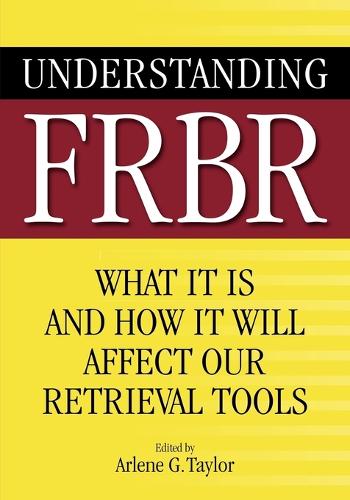
Understanding FRBR by Arlene G Taylor
What is FRBR, and why is everyone talking about it? Is it really going to revolutionize cataloguing? And if so, what form will it take? This book is written for librarians, bibliographic systems designers, library and information science faculty and students, and anyone else who is interested in learning about the Functional Requirements for Bibliographic Records (FRBR) and how following the FRBR model can improve access to information through helpful organization of the metadata records that are surrogates for information resources. Serials, art, music, moving images, maps, and archival materials are just a few of the formats covered. Not for catalogers only!
Understanding FRBR. . features chapters contributed by leading authorities in the cataloging field. . . . It offers a basic introduction to FRBR, discussions about FRBR, FRAD (functional requirements for authority data), and RDA (resource description and access), and the issues involved in using FRBR in nontraditional library settings such as with cartographic materials and music. Both books are well illustrated and include numerous bibliographical resources.' [Reviewed in conjuntion with FRBR: A Guide for the Perplexed]. * Library Journal *
Understanding FRBR is clearly written, well illustrated (many of the concepts are clarified by very helpful diagrams), and well indexed; additionally, chapters feature extensive bibliographies, many of which provide URLs to the IFLA groups' documents. While it may seem that this book is of interest only to catalogers, the application of FRBR will change the structure of catalog and the systems used to store and display it; therefore, it is an important text for systems librarians, reference librarians, and anybody else interested in the future of the organization and display of bibliographic information. * College & Research Libraries *
The emergence of this textbook is testimony to the breadth and depth of work done to date. It documents much of that work, and provides a good basic introduction to FRBR that is broadly understandable. . . . The relational concepts within FRBR are complicated and can be challenging. This book does a good job of illuminating them in a straightforward manner. It also describes how the application of the FRBR concepts could improve our systems of bibliographic access in very specific ways. . . . For those of us that really want or need to be able to predict the impact that FRBR will have on our work, this is an accessible explanation of the current state of the art. As such it is a real contribution to our understanding. * TechKNOW *
Taylor and her contributors cover FRBR and introduce the reader to FRAD as well. . . . All chapters conclude with current and useful references to further reading and more information. * Booklist *
Arlene Taylor and her compadres don't even try to teach you how to construct a hierarchical record. Instead, they direct their efforts toward showcasing what's possible when digital technology and traditional cataloging practice meet. This is the future of cataloging. * Library Media Connection *
Understanding FRBR is a useful and timely book that brings together recent developments in FRBR and offers several assessments of it. * Technicalities *
No cataloguer, bibliographic systems designer or library and information science lecturers and students should be without this book. It is a useful resource in acquiring an understanding of what FRBR is about and how it will change the way in which cataloguers will think about cataloguing in future. * The Electronic Library *
Understanding FRBR is clearly written, well illustrated (many of the concepts are clarified by very helpful diagrams), and well indexed; additionally, chapters feature extensive bibliographies, many of which provide URLs to the IFLA groups' documents. While it may seem that this book is of interest only to catalogers, the application of FRBR will change the structure of catalog and the systems used to store and display it; therefore, it is an important text for systems librarians, reference librarians, and anybody else interested in the future of the organization and display of bibliographic information. * College & Research Libraries *
The emergence of this textbook is testimony to the breadth and depth of work done to date. It documents much of that work, and provides a good basic introduction to FRBR that is broadly understandable. . . . The relational concepts within FRBR are complicated and can be challenging. This book does a good job of illuminating them in a straightforward manner. It also describes how the application of the FRBR concepts could improve our systems of bibliographic access in very specific ways. . . . For those of us that really want or need to be able to predict the impact that FRBR will have on our work, this is an accessible explanation of the current state of the art. As such it is a real contribution to our understanding. * TechKNOW *
Taylor and her contributors cover FRBR and introduce the reader to FRAD as well. . . . All chapters conclude with current and useful references to further reading and more information. * Booklist *
Arlene Taylor and her compadres don't even try to teach you how to construct a hierarchical record. Instead, they direct their efforts toward showcasing what's possible when digital technology and traditional cataloging practice meet. This is the future of cataloging. * Library Media Connection *
Understanding FRBR is a useful and timely book that brings together recent developments in FRBR and offers several assessments of it. * Technicalities *
No cataloguer, bibliographic systems designer or library and information science lecturers and students should be without this book. It is a useful resource in acquiring an understanding of what FRBR is about and how it will change the way in which cataloguers will think about cataloguing in future. * The Electronic Library *
Arlene G. Taylor is Professor Emerita, School of Information Sciences, University of Pittsburgh, and author of several works on cataloging and classification and authority control. She has received ALA's Margaret Mann Citation in Cataloging and Classification and the ALA Highsmith Library Literature Award.
| SKU | Unavailable |
| ISBN 13 | 9781591585091 |
| ISBN 10 | 1591585090 |
| Title | Understanding FRBR |
| Author | Arlene G Taylor |
| Condition | Unavailable |
| Binding Type | Paperback |
| Publisher | Bloomsbury Publishing Plc |
| Year published | 2007-11-30 |
| Number of pages | 192 |
| Cover note | Book picture is for illustrative purposes only, actual binding, cover or edition may vary. |
| Note | Unavailable |