


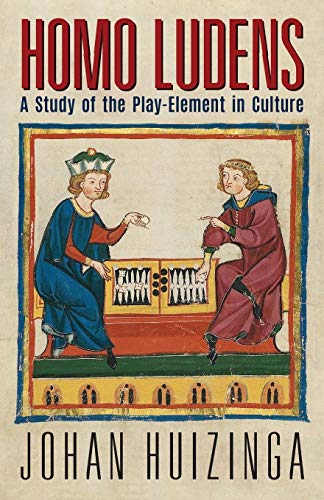

Homo Ludens by Johan Huizinga
In Homo Ludens, Johan Huizinga defines play as the central activity in flourishing societies. He identifies five characteristics of play: it is free; it is not ordinary or real life; it is distinct from ordinary life both as to locality and duration; it creates order; it is connected with no material interest, and from it no profit can be gained.With cross-cultural examples from the humanities, business, and politics, Huizinga examines play in all its diverse guises--as it relates to language, law, war, knowledge, poetry, myth, philosophy, art, and much more. As he writes, Civilization is, in its earliest phases, played. It does not come from play like a baby detaching itself from the womb: it arises in and as play, and never leaves it.
Starting with Plato, Huizinga traces the contribution of man the player through the Middle Ages, the Renaissance, and early modern world. With an eye for our own times he writes: In American politics play] is even more evident. Long before the two-party system had reduced itself to two gigantic teams whose political differences were hardly discernible to an outsider, electioneering in America had developed into a kind of national sport. With its remarkable historical sweep, Homo Ludens defines play for generations to come.
A fascinating account of 'man the player' and the contribution of play to civilization.--Harper's
A writer with a sharp and powerful intelligence, helped by a gift of expression and exposition which is very rare, Huizinga assembles and interprets one of the most fundamental elements of human culture: the instinct for play. Reading this volume, one suddenly discovers how profoundly the achievements in law, science, poverty, war, philosophy, and in the arts, are nourished by the instinct of play.--Roger Caillois, editor of Diogenes
-
 Suicide
-
 Consuming Places
-
 After Method
-
 The Sociology of Nationalism
-
 Sociology Beyond Societies
-
 Non-Representational Theory
-
 Adorno on Music
-
 The Badlands of Modernity
-
 Teratologies
-
 Brands
-
 Theories of the Information Society
-
 Sociology of Postmodernism
-
 Social Learn&Imitation Ils 254
-
 Multicultural Horizons
-
 Homo Ludens ILS 86
-
 Prosthetic Culture
-
 Giddens' Theory of Structuration
-
 Professions and Patriarchy
-
 Places on the Margin
-
 Gender Transformations
-
 States of Knowledge
-
 Spaces of Identity
-
 Adolescence
-
 Apprenticeship
-
 Inst Of Private Law Ils 208
-
 Voluntary Work in the Welfare State
-
 Educ Borstal Boys Ils 204
-
 Education in Transition
-
 Theory of Collective Behaviour
-
 The Danube Basin and the German Economic Sphere
-
 The Economic Development of the Middle East
-
 Working with Unattached Youth
-
 The Revolution in Anthropology Ils 69
-
 State and Economics in the Middle East
-
 Class American Socty Ils 103
-
 Criminal Justice and Social Reconstruction
-
 Education & Society in Modern France Ils 219
-
 The Japanese Village Ils 56
-
 Economics of Migration
-
 Penelope Hall's Social Services of England and Wales
-
 A Chinese Village
-
 Soviet Legal Theory Ils 273
-
 The Ideal Foundations of Economic Thought
-
 Process Of Independence Ils 51
-
 How People Vote
-
 The Nationalities Problem & Soviet Administration
-
 Studies Class Struct Ils 121
-
 Soc Relign Pt1:Est Relg Ils 79


| SKU | Unavailable |
| ISBN 13 | |
| ISBN 10 | |
| Title | Homo Ludens |
| Author | Johan Huizinga |
| Series | |
| Condition | Unavailable |
| Binding Type | |
| Publisher | |
| Year published | |
| Number of pages | |
| Cover note | Book picture is for illustrative purposes only, actual binding, cover or edition may vary. |
| Note | Unavailable |


Customers who bought this item also bought
Atomic Habits

All About Love

The Whole-Brain Child

No Bad Parts


Capable
The Comfort Crisis
The Silva Mind Control Method
The Way of Excellence

The Red Book

The Hold Me Tight Workbook

I Hate You - Don't Leave Me: Third Edition

ADHD is Awesome

Range

Supercommunicators

The Anxious Generation
Strong Ground
Mating in Captivity

The Boy Who Was Raised as a Dog, 3rd Edition

Healing Add


Self-Directed Dbt Skills
The Complete Illustrated Kama Sutra

View All Editions
Applied Filters (0)
Sort by:
Loading editions...