


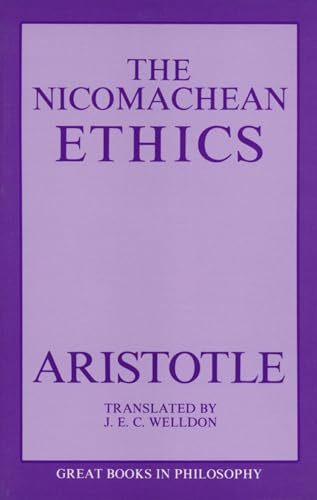
The Nicomachean Ethics by Aristotle
What is the good life? How can we attain true happiness? How are we to understand the concepts of good, bad, right, wrong, virtue, and vice as they intermingle and pervade the human actions that make up society? In one of the earliest and most comprehensive attempts to offer a systematic treatment of ethics and the principles upon which it rests, the Greek philosopher Aristotle seeks to give substance and meaning to human action and to the manner in which we judge our own behavior and that of others. Here Aristotle not only offers a discussion of morality that later culminated in a full-blown analysis of political life, but he also sets forth principles and advice that served as the touchstone for many subsequent moral philosophies.
ARISTOTLE was born in the northern Greek town of Stagira in 384 B.C.E., where his father was the personal physician to the great-grandfather of Alexander the Great. At the age of eighteen Aristotle entered Plato's Academy and soon became recognized as its most important student. He remained under Plato's tutelage for nearly twenty years. After his teacher's death in 347 B.C.E., Aristotle cultivated associations with other Academy students throughout Greece and Asia Minor. Then in 342 B.C.E., Aristotle was asked by King Philip II of Macedonia to become the tutor for his young son Alexander, who was later to become the conqueror of much of the known world at that time. The young prince remained under Aristotle's supervision until 336 B.C.E., when he acceded to the throne after his father's death. Two years later Aristotle returned to Athens and founded his own school, which he called the Lyceum. This intellectual center flourished during the years when Alexander the Great ruled Greece as part of his large empire. But upon Alexander's death in 323 B.C.E., Aristotle was charged with impiety by Athenians who resented his associations with the Macedonian conqueror. Rather than risk the same fate as Plato's mentor, Socrates, Aristotle fled to the city of Chalcis, where he died in 322 B.C.E. Aristotle's interests, like those of Plato, were diverse and his writing cast its shadow on many fields, including logic, metaphysics, epistemology, ethics, politics, and the sciences. Among his most well-known works are: The Categories, The Prior and Posterior Analytics, The Physics, The Meta-physics, De Anima, The Nicomachean Ethics, and The Politics.
| SKU | Unavailable |
| ISBN 13 | 9780879753788 |
| ISBN 10 | 0879753781 |
| Title | The Nicomachean Ethics |
| Author | Aristotle |
| Series | Great Books In Philosophy Ser |
| Condition | Unavailable |
| Binding Type | Paperback |
| Publisher | Prometheus Books |
| Year published | 1987-02-01 |
| Number of pages | 358 |
| Cover note | Book picture is for illustrative purposes only, actual binding, cover or edition may vary. |
| Note | Unavailable |