


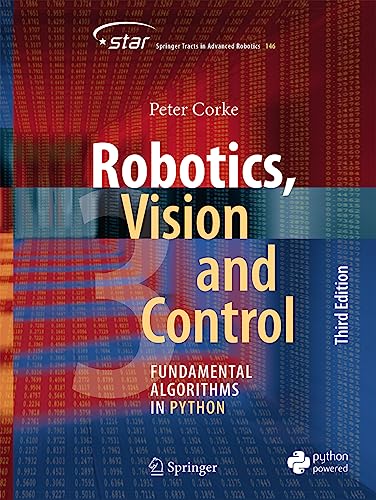
Robotics, Vision and Control by Peter Corke
The code can also be the starting point for new work, for practitioners, students, or researchers, by writing programs based on Toolbox functions, or modifying the Toolbox code itself.-
 Comparative Performance of US Econometric Models
-
 Robotics Research
-
 Ergonomics in Robotics: Advances and Innovations
-
 Applied Guidance Methodologies for Off-road Vehicles
-
 Robot Dynamic Manipulation
-
 Reinforcement Learning of Bimanual Robot Skills
-
 Shoaling with Fish: Using Miniature Robotic Agents to Close the Interaction Loop with Groups of Zebrafish Danio rerio
-
 Wording Robotics
-
 Human-Aware Robotics: Modeling Human Motor Skills for the Design, Planning and Control of a New Generation of Robotic Devices
-
 Distributed Autonomous Robotic Systems
-
 Self-Organizing Robots
-
 Structure from Motion using the Extended Kalman Filter
-
 Visual Perception and Robotic Manipulation
-
 Stochastic Reactive Distributed Robotic Systems
-
 Software Engineering for Experimental Robotics
-
 Type Synthesis of Parallel Mechanisms
-
 Cable-Driven Parallel Robots
-
 Delft Pneumatic Bipeds
-
 Incremental Learning for Motion Prediction of Pedestrians and Vehicles
-
 Musical Robots and Interactive Multimodal Systems
-
 Learning Motor Skills
-
 FastSLAM
-
 The DARPA Urban Challenge
-
 Random Finite Sets for Robot Mapping & SLAM
-
 Multiple Heterogeneous Unmanned Aerial Vehicles
-
 The Human Hand as an Inspiration for Robot Hand Development
-
 Algorithmic Foundations of Robotics VIII
-
 Approaches to Probabilistic Model Learning for Mobile Manipulation Robots
-
 Experimental Robotics IX
-
 Algorithmic Foundations of Robotics IX
-
 Robotic Systems for Handling and Assembly
-
 Advances in Robotics Research: From Lab to Market
-
 Analysis and Synthesis of Compliant Parallel MechanismsScrew Theory Approach
-
 Cells and Robots
-
 Visual Guidance of Unmanned Aerial Manipulators
-
 Exoskeletons in Rehabilitation Robotics
-
 The DARPA Robotics Challenge Finals: Humanoid Robots To The Rescue
-
 Efficient Topology Estimation for Large Scale Optical Mapping
-
 Field and Service Robotics


“The book, nearly 800 pages, has 16 chapters... Almost every chapter includes wrap-ups, recommendations for further reading, and exercises, and sometimes additional resources. ... There are numerous color illustrations. The book has many features, including exercises that help pedagogy. This updated third edition will be very useful for students, researchers, and professionals interested in robotics and its practical applications.” (S. V. Nagaraj, Computing Reviews, March 25, 2024)
Peter Corke is a robotics educator and researcher. He is known for his work in vision-based control and field robotics, as well as open-source robotics software and educational resources such as the QUT Robot Academy. He is a distinguished professor at the Queensland University of Technology and a technical advisor to several robotics companies. He was the Australian University Teacher of the Year in 2017 and is a fellow of the IEEE, the Australian Academy of Technology and Engineering, and the Australian Academy of Science. He received his PhD from the University of Melbourne.
| SKU | Unavailable |
| ISBN 13 | 9783031064685 |
| ISBN 10 | 3031064682 |
| Title | Robotics, Vision and Control |
| Author | Peter Corke |
| Series | Springer Tracts In Advanced Robotics |
| Condition | Unavailable |
| Binding Type | Paperback |
| Publisher | Springer International Publishing AG |
| Year published | 2023-08-08 |
| Number of pages | 824 |
| Cover note | Book picture is for illustrative purposes only, actual binding, cover or edition may vary. |
| Note | Unavailable |